
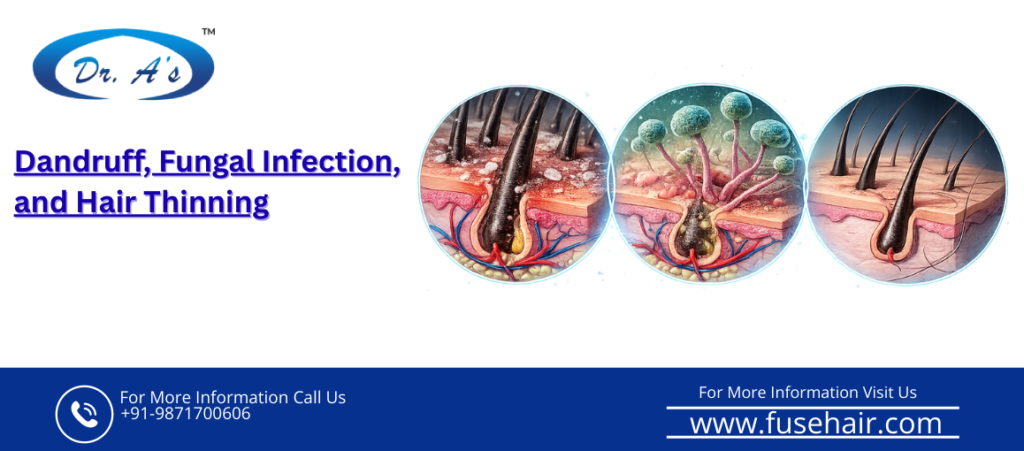

People consider hair thinning as an aesthetic issue which actually indicates underlying problems that develop on their scalp. People frequently overlook dandruff and fungal infections as hair loss because these conditions silently harm the scalp and cause gradual damage to hair roots. Dandruff causes hair loss because it creates a direct link which researchers must understand for their purpose of achieving permanent healthy hair development.
Our blog examines the process through which scalp conditions result in hair thinning while explaining methods to avoid both dandruff and hair loss and demonstrating effective home treatments and identifying the situations which require advanced treatments such as hair loss treatment in Delhi and hair transplant procedures in Delhi.
The Link Between Dandruff and Hair Loss
People consider dandruff to be a minor problem which produces white flakes on the scalp together with itching and dryness. Persistent dandruff causes scalp inflammation which disrupts its normal balance. The inflammation process damages hair follicles which results in excessive hair loss and noticeable hair thinning.
People with severe dandruff develop scalp fungus hair loss because fungal infections consume the scalp’s protection against hair loss. This process creates a detrimental atmosphere which prevents hair growth and results in diffuse hair loss or patchy bald spots.
Fungal Infections: A Silent Cause of Hair Thinning
Seborrheic dermatitis and tinea capitis are two common scalp fungal infections which people tend to underestimate their occurrence in humid areas. The infections lead to symptoms which include redness and itching and excessive oil production and flaky skin formation.
When fungal infections remain untreated they create blockages in hair follicles which stop oxygen and nutrients from reaching hair roots. The process leads to hair thinning which becomes visible after an extended period and develops into excessive hair loss. People who have scalp fungus experience hair loss which becomes worse through self-treatment methods and the application of strong anti-dandruff products without professional advice.
Common symptoms you shouldn’t ignore
People who have either of these symptoms should know that their hair loss is due to either dandruff or fungal infection.
- Dandruff persists in the hair even after people use anti-dandruff shampoos.
- The scalp develops an itchy and oily condition which results in visible inflammation.
- There is scalp sensitivity along with a burning feeling.
- The hairline and crown area of the head show signs of hair loss.
- The person feels scalp sensitivity together with a burning sensation.
How to Hinder Dandruff and Hair Loss Naturally?
The method of avoiding scalp disorders begins through proper scalp care. The following methods have scientific backing to show their effectiveness in stopping dandruff and hair loss.
- Scalp cleaning practices require you to wash your hair with dermatologist-approved gentle shampoos at regular intervals.
- Over-oiling hair leads to increased fungal growth problems for people with excessive oiling issues.
- Stress management helps people because stress makes their body defenses weaker and causes scalp problems.
- Hair loss becomes worse when people lack iron and zinc and biotin through their diet.
- The use of styling products should be avoided because they create too much chemical exposure which harms the protective layer of the scalp.
Home Remedies for Dandruff and Hair Loss
People search for home remedies dandruff and hair loss which they can use before they decide to seek professional medical advice. The remedies provide assistance for minor issues but they should work together with medical treatment.
The most effective home remedies consist of
- Tea tree oil – Known for antifungal properties
- Aloe vera gel – Soothes inflammation and itching
- Neem rinse – Helps control fungal growth
- Apple cider vinegar (diluted) – Restores scalp pH balance
When to Seek Professional Hair Loss Treatment in Delhi
Excessive dandruff and fungal infections can lead to hair follicles entering their dormant stage when these conditions remain untreated for an extended period. This is where hair loss treatment in Delhi becomes crucial.
The medical procedures that professionals perform include:
- Medicated antifungal therapies
- Scalp detox and clinical dandruff treatments
- PRP therapy to revive weakened follicles
- Personalized hair regrowth plans
Advanced Hair Loss: Is Hair Transplant the Solution?
Permanent hair follicle damage requires hair transplant procedures because medical treatments fail to restore normal function. This is where hair transplant in Delhi offers a permanent solution.
FUE (Follicular Unit Extraction) represents the most advanced hair restoration technique because it enables natural-looking results with minimal recovery time. The FUE hair transplant cost in India depends on three factors:
- Number of grafts required
- Severity of hair loss
- Surgeon’s expertise
- Clinic location and technology used
Conclusion
Dandruff together with fungal infections bring hidden damage to hair roots which results in hair thinning and excessive hair loss. The early detection of dandruff together with hair loss enables people to stop permanent hair damage from occurring. Through effective scalp treatment and immediate medical care together with specialized hair loss treatment in Delhi, you can achieve scalp restoration and follicle strengthening while preventing permanent hair loss.

Dr. Arvind Poswal
Dr. Arvind Poswal is a hair transplant specialist, dermatologist, inventor, author, and teacher with a deep passion for advancing hair restoration. With medical training from Armed Forces Medical College, Pune and dermatology training in Australia, he has spent years exploring better more natural approaches to hair restoration. His expertise includes FUE/FUSE hair transplantation, beard-to-scalp transplantation, aesthetic procedures, and regenerative therapies. He has authored books, trained fellow doctors and contributed to innovations in hair restoration while being associated with leading international hair restoration societies.