
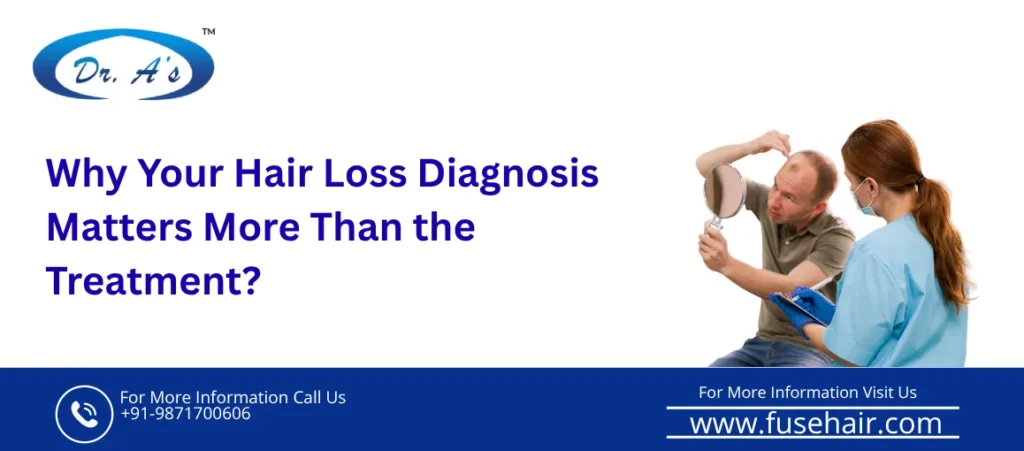

So, before you invest hundreds of dollars in a new hair growth serum or schedule your next visit based on a trend you saw on social media, you really need to tackle the fundamentals-Your Diagnosis of hair loss. Until you understand what causes your hair loss-that’s the only thing that will ever successfully treat it.
The Problem with Chasing Treatment Trends
The hottest new hair-loss treatment comes along every few months: Rosemary oil, red light therapy, microneedling, scalp massages in exotic carrier oils etc. While some treatments might have solid science behind them others don’t beyond testimonial-based evidence backed by smart marketing.
The issue isn’t so much whether these treatments are effective for people in general-some of them are for specific types of hair loss-as that everyone seems to jump a few steps and completely skip knowing the underlying problem causing the hair loss before attempting treatment.
As an improperly diagnosed hair loss sufferer you are gambling: this is money lost, time lost and crucially potential time gained, on hair loss issues, that when the window of opportunity for the greatest chance at recovery is most responsive, you continue to pass while guessing treatments.
Why Hair Loss Is Not a One-Size-Fits-All Problem
Loss of hair can arise from a vast number of reasons, of which some are very common including:
i) Androgenetic alopecia (genetic pattern hair loss) – responsible for the most hair loss in both men and women.
ii) Telogen effluvium – shedding can temporarily occur under many stimuli such as stress, illness, poor diet or changes to hormone levels.
iii) Alopecia areata – a condition whereby your immune system attacks your hair follicles.
iv) Traction alopecia – commonly induced from a constant, continuous physical stress applied to the hair. This can arise, for example from pulling the hair too tightly.
v) Scalp conditions such as seborrheic dermatitis, psoriasis and fungal conditions.
vi) Hypothyroid or anaemic disorders – medical issues can cause diffuse loss of hair across the scalp, such as thyroid problems or anaemia.
vii) Post natal – hormone-led loss. Many women suffer postnatally from hormonal-based loss of hair, but this usually regrows within 6 months.
Each and every one of the underlying causes would require a completely different course of action; a treatment that works for those of genetic origin may be utterly pointless-and even detrimental-to those suffering hormonal or anaemic hair loss.
This is precisely why it is essential to determine what type of hair loss and the particular trigger responsible before commencing a treatment protocol.
What a Proper Hair Loss Diagnosis Actually Involves?
Detailed Diagnosis Goes Much Further.
A qualified hair specialist will:
i) Go through your medical history with you-including family history
ii) View your scalp through an eyepiece, in the form of either a trichoscope or a dermoscope- to view the hair follicles in question, the miniaturization of your hair follicles, and the conditions of your scalp.
iii)Categorize how your hair loss occurs, either through established scale systems such as the Norwood Scale for men, or the Ludwig Scale for women
iv) Request that you have the appropriate blood tests taken, (e.g.thyroid level blood tests, iron blood tests, vitamin D, DHT levels)
v) Also go through recent levels of stress in your life, changes in diet, new medication that has been prescribed to you, or any recent hormonal related occurrences such as childbirth.
This procedure takes time to undertake. However it gives the hair specialist-and importantly- you a clear-cut, evidence-based explanation of exactly why your hair is thinning and the ways it is happening. Consequently any advice you then receive will be evidence-based advice and not guesswork.
When Treatment Trends Become Genuinely Harmful?
Since the majority of trend-based treatments are harmless if they do not result in actual benefits-and are therefore just a waste of money and time-where hair loss is the reason for treatment, some are indeed actually dangerous. The wrong diagnosis of a person’s cause of hair loss causes genuine suffering. The undiagnosed scalp infection sufferer using a hair growth serum that can in turn further restrict blood flow to already infected skin; the individual with current alopecia areata which is aggravated by inappropriate aggressive derma rolling on the scalp; the suspected sufferer of male patterned hair loss-taking a dht blocker for a reason that is actually low ferritin, that causes yet more stress to an already compromised system. The possibilities are too numerous and far too common in practice where there is a simple explanation of treating symptoms in ignorance of cause.
The Right Sequence Always Starts with Diagnosis
Regardless of your age, gender and the duration of hair loss, the proper procedure will always be the same.
First: Seek a correct clinical diagnosis from a specialist.
Second: Know your hair loss type,stage and the probable course of the hair loss.
Third: Know your appropriate treatments that match with your hair loss condition.
Fourth: Set a realistic timeline as the hair takes its time to respond and it counts to be consistent.
Fashions come and go. A product which once revolutionized the internet may be already outdated or proved wrong. A diagnosis however provides a stable basis which fashion cannot overthrow.
Conclusion
Hair loss is incredibly personal. It impacts your self-esteem, your identity and the way you navigate your day. That’s why it calls for considered responses, evidence-based strategies – rather than knee-jerk, trending, social media quick-fixes.
Getting the diagnosis for your hair loss correct isn’t a slow process, it’s a smart one. It’s the step that ensures any subsequent steps taken – medical, procedural, surgical – are targeting your specific issue and giving you the strongest chance of success.
Every Fuse Hair patient journey starts with in-depth diagnostic consultation. A specialist considers your hair loss on the inside out before proposing treatment options – because the right diagnosis is the real results foundation.

Dr. Arvind Poswal
Dr. Arvind Poswal is a hair transplant specialist, dermatologist, author, inventor and teacher. Trained at Armed Forces Medical College, Pune and in Australia, he specializes in FUE/FUSE, beard-to-scalp transplantation, aesthetic procedures and regenerative hair restoration techniques with 25+ years of experience.
- Hair transplant specialist
- 25+ years experience
- Father of Hair Transplants in India