
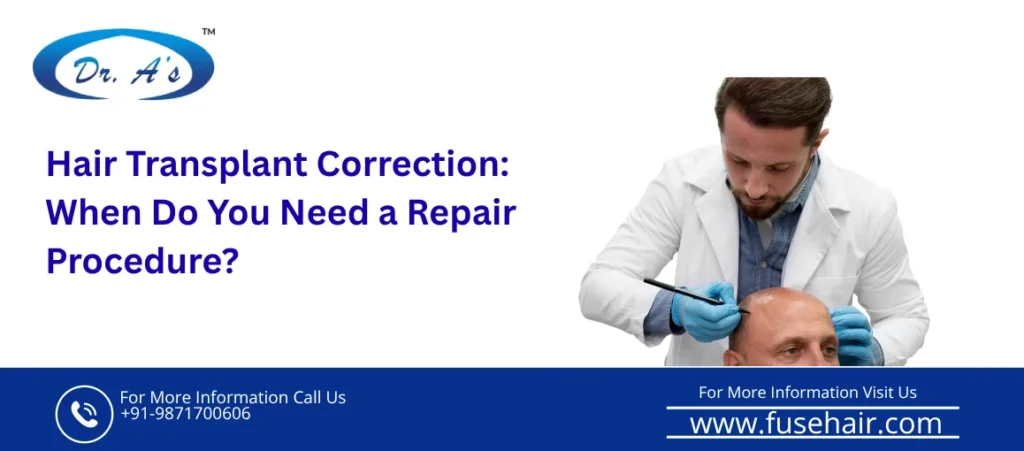

Hair transplant correction is required if your original transplant was botched and the results failed to produce a natural hairline and density (while concealing or minimizing scarring, or patching hair). If your transplant didn’t result in an acceptable outcome, you are in good company, and the good news is, it is often treatable.
What Is a Hair Transplant Correction?
A hair transplant correction, also referred to as repair, is an advanced surgical procedure used to remedy or correct the results of a prior hair transplant. These are not standard surgeries; the surgeon who corrects such procedures needs experience on working with existing grafts, scarring and also limitations of the donor area.
Hair transplant correction is a more technically challenging procedure to perform than a primary transplant. The surgeon needs to establish what had failed and where/why it had failed and to establish what is physically achievable with a hair transplant repair.
Common Reasons People Seek a Hair Transplant Correction
No two bad FUE sessions look the same: These are the top reasons patients visit an FUE correction specialist:
i) An unnatural or too-low hairline – A hairline positioned too far forward or designed without anticipating future hair loss leads to an appearance that can look strange as a patient continues to age.
ii) Pluggy or doll-like results – Earlier hair transplantation techniques (e.g., punch graft) were sometimes performed with follicular units packed too tightly together, resulting in a very peculiar and easily recognizable hair line.
iii) An unnatural hairline design – Unnatural placement, angular shape, or overly linear pattern of the implanted hairline.iv)An unnatural and uneven result with gaps – Places on the head where hair has grown unevenly leading to unnatural gaps in the recipient area.
iv) Over-harvested donor sites -Donor sites with thinning that can be difficult to conceal with standard hairstyles.
v) A visible linear scarring from FUT-Often stretched out and very difficult to cover even with longer hair-strip method scar of FUT.
vi) Non-recovery from shock loss – After transplants, some of the patient’s original hair may fall out surrounding the graft site or, in some rarer instances, elsewhere on the head.
Normal density returns in most cases, but in others it is not-often seen on the temple areas. If you are unhappy with your FUE results and any of the points above are relevant, your journey may lead you to FUE correction.
How Is a Hair Transplant Correction Performed?
It really depends on how the original procedure went wrong. There is no “one size fits all” to hair transplant repair- the surgical plan is tailored to the individual.
i) Unnatural hairline. Existing grafts may be removed or redistributed and a natural, softer hairline created using single-hair grafts.
ii) Pluggy hair transplant. Denser planting of 1 & 2-hair grafts into the gaps between existing plug-like results will help to disperse the plug appearance and mimic a natural result.
iii) Scar revision. FUE may be transferred onto a linear FUT scar to camouflage it, SMP could be used in conjunction with FUE to cover it.
iv) Patchy/poor density. More grafts can be placed on any thin areas- if donor stock remains- from the donor site to improve density.
Care must be taken by the surgeon to look at any planned hair transplant revision; only a finite supply of donor hair is available throughout a lifetime and the donor reserve must be carefully checked, prior to undertaking any repair strategy.
Who Is a Good Candidate for a Correction Procedure?
You would be a good candidate for a correction procedure if:
i) You had a hair transplant of 12-18 months ago (so that all results from your initial surgery were finalised)
ii) You are disappointed in a clearly definable way as to the results of your previous surgery
iii) You have adequate donor hair available for further grafting
iv) You are in reasonably good general health with realistic expectations
Not every result can be improved in the same way. Factors can prevent some degree of correction, for instance a donor area so badly thinned as to be limited.
The Role of PRP in Supporting Correction Results
Most people who have to get their hair transplant corrected find they are suitable for PRP (Platelet-Rich Plasma) add-on treatment. Platelet-rich plasma therapy involves the injection of concentrated growth factors obtained from your own blood, in the targeted area. It works to promote growth, better graft survival and condition the native hair surrounding the corrected area of hair transplant.
If you are considering the costs from a hair transplant clinic in Delhi, hair PRP cost in Delhi should also be clarified with your surgeon when you discuss your hair transplant correction.
PRP add-on therapy will often be used both before and after hair transplantation correction in Delhi.
Conclusion: A Poor Result Is Not the End of the Story
Feeling it didn’t quite work and being disappointed about hair transplant can be demoralising, but it’s most often completely reversible. Hair transplant correction surgeries have assisted countless patients get the desired naturally fuller look back and have boosted their confidence beyond measure. Choosing the correct specialist the second time is crucial, so if you’re even looking at whether to have a repair or be guided about your current outcome-contacting the right specialists should be the initial step. It should be equally taken into consideration that if you are undecided about the cost associated with a male hair transplant in Delhi between correction and a new procedure, it will surely shed light upon most apt decisions, clinically.

Dr. Arvind Poswal
Dr. Arvind Poswal is a hair transplant specialist, dermatologist, author, inventor and teacher. Trained at Armed Forces Medical College, Pune and in Australia, he specializes in FUE/FUSE, beard-to-scalp transplantation, aesthetic procedures and regenerative hair restoration techniques with 25+ years of experience.
- Hair transplant specialist
- 25+ years experience
- Father of Hair Transplants in India