
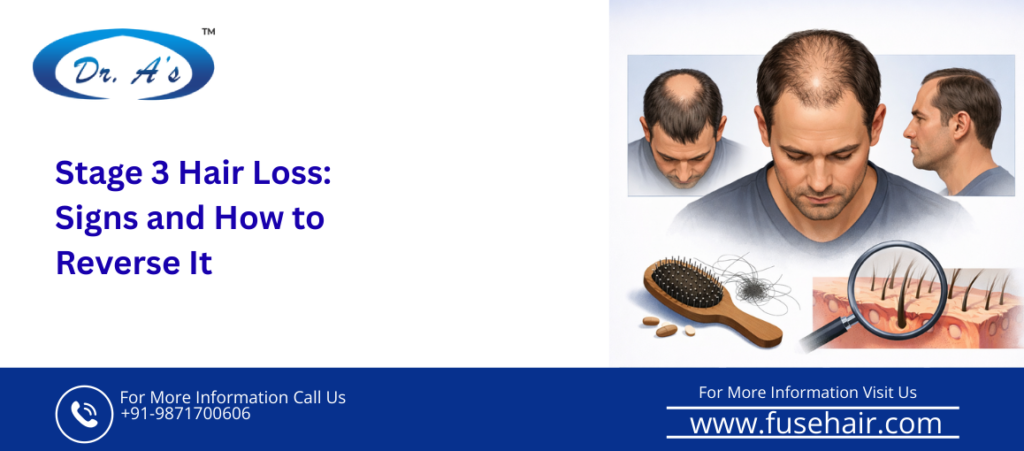

People begin losing their hair in a slow manner. The third stage of hair loss demonstrates clear physical changes which become evident to others. The stage marks a critical moment in male pattern baldness because men experience their first visible hair loss through decreasing hair density. You can start treatment early at this stage to minimize hair loss through appropriate treatment methods.
The blog will investigate stage 3 hair loss by showing its appearance and its initial signs and its underlying causes and the most effective current treatment methods.
Understanding Stage 3 Hair Loss
The Norwood Scale functions as a system for classifying male hair loss which describes stage 3 hair loss. At this stage:
The hairline recedes noticeably at the temples
The classic “M-shaped” pattern becomes visible
The frontal area of the head experiences decreased hair density
Thinning may begin at the crown (in some cases)
The earlier stages display slight hair loss but stage 3 hair loss shows advanced visible progression of male pattern baldness.
Early Signs of Stage 3 Hair Loss
The initial indicators of third-stage hair loss show its first signs. The following signs should be monitored to determine the condition.
Receding Hairline
The hairline begins to recede backward from the front hairline which starts first at the temples.
Thinning at the Crown
You will observe increased scalp visibility when you look at your hair under strong illumination.
Increased Hair Exfoliating
The amount of hair that falls out during washing and combing has become more visible.
Lower Hair Density
Hair looks thinner and weaker with less volume than before.
Stage 3 hair loss develops because of genetic factors
Male pattern baldness occurs because men have sensitivity to dihydrotestosterone (DHT), which causes gradual hair follicle shrinkage.
Other factors that contribute to this condition include:
- Hormonal imbalance
- Stress and poor lifestyle habits
- Lack of Nutritional
- Medical conditions
- Smoking and absence of proper scalp maintenance
Can Stage 3 Hair Loss Be Inverse?
The ability to reverse Stage 3 hair loss depends on your chosen methods of treatment for the condition. Complete hairline restoration requires surgical procedures although multiple effective treatments exist which improve hair density while reducing future hair loss.
Medications
1.Minoxidil
The topical solution works by increasing blood circulation to hair follicles, which leads to hair regrowth. The solution shows optimal results during the initial phase of stage 3 hair loss.
2.Finasteride
The oral medication prevents DHT production, which helps to decrease the rate of male pattern baldness development.
These medications serve as initial treatment options that can postpone the requirement for surgical interventions.
Non-Surgical Hair Regrowth Treatments
Current dermatological practices provide innovative hair restoration solutions which include:
- PRP Therapy
- GFC Therapy
- Laser Therapy
These methods activate inactive hair follicles while they enhance the strength of existing hair. When considering options, patients often research hair regrowth treatment costs in India to understand affordability. The expenses differ according to the level of expertise at the clinic and the technological resources used and the total treatment sessions needed.
In urban regions, multiple people search for information about hair loss treatment expenses which are available in Delhi because the capital city has numerous advanced hair restoration facilities.
Hair Transplant Surgery
Surgical restoration becomes the most effective treatment when hair follicles in the affected region stop functioning permanently.
How It Works
Surgeons take hair follicles from the donor area which typically comes from the back of the scalp and then they place these follicles into areas with thinning hair.
Techniques:
- FUE
- FUT
Patients investigate hair transplant surgery in India because the country provides access to top-level medical professionals who work at lower expenses than other locations. India has established itself as a leading international destination for hair restoration treatments which attract patients from both the country and abroad.
How Much Do Treatments Cost?
The right solution needs cost understanding which helps in the planning process.
The hair loss treatment cost in Delhi depends on three factors which are clinic reputation and treatment type and number of sessions.
The hair regrowth treatment cost in India depends on the treatment option selected which includes PRP and medications and combination therapy.
The hair transplant surgery in India is lower than Western countries but the country delivers high medical standards.
Conclusion
The most effective method to manage and control hair loss progression occurs when people identify stage 3 hair loss at its earliest point. The combination of medical guidance and lifestyle improvements and advanced solutions such as hair transplant surgery in India enables people to regain their hair density and self-assurance. The process to achieve permanent natural-looking results and stop hair shedding requires three essential steps which include emergency response and accurate diagnosis and customized treatment design.

Dr. Arvind Poswal
Dr. Arvind Poswal is a hair transplant specialist, dermatologist, author, inventor and teacher. Trained at Armed Forces Medical College, Pune and in Australia, he specializes in FUE/FUSE, beard-to-scalp transplantation, aesthetic procedures and regenerative hair restoration techniques with 25+ years of experience.
- Hair transplant specialist
- 25+ years experience
- Father of Hair Transplants in India