
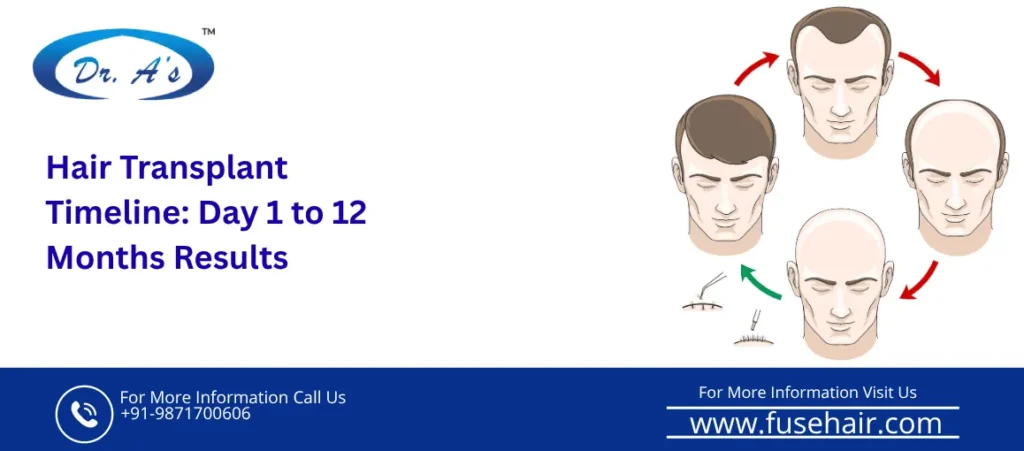

Hair transplantation has become one of the most effective solutions for restoring natural hair growth. Many people develop anxiety when they do not see immediate changes because they expect to see instant results. The hair restoration process takes time because it follows a specific timeline for hair transplant results. Patients who understand the hair transplant growth stages will know what to expect from their initial day of surgery until they receive their complete results after one year.
Our blog will provide a detailed explanation of the hair transplant month by month which will include information about the recovery period and shedding and new hair growth phases.
Understanding the Hair Transplant Procedure
A hair transplant procedure starts with the extraction of healthy hair follicles from the donor area which typically comes from the back of the scalp. The most common techniques include FUE and FUT.
The hair transplant procedure requires several hours of operation time though its hair transplant recovery timeline and hair growth process extend several months. Patients often ask how long hair transplant takes to grow, and the answer depends on the natural hair cycle.
Day 1 to Day 3: Quick Post-Surgery Stage
The following section provides information about upcoming events.
Mild swelling and redness will develop in the area which received treatment
Small scabs will begin to form around the hair follicles which received transplantation
The scalp area will experience mild discomfort which feels like tightness
The doctor prescribed medications will assist with the patient’s recovery process
Patients must adhere to the post-operative guidelines which their best hair transplant doctor in Delhi provided during this period.
Important care tips:
The scalp should remain untouched because people should not touch or scratch it
The person needs to keep their head elevated during sleep
The person should avoid doing any strenuous exercise
The person needs to follow the instructions for washing their hair which require gentle handling of their scalp.
Week 1 to Week 2: Scab Healing and Recovery
Scalps start healing during the first two weeks because scabs begin to remove themselves from the skin.
Key developments:
Scabs start disappearing
Redness decreases to a large extent
The transplanted hair follicles establish themselves in their permanent scalp position
Most patients can resume their regular daily routines
Month 1: Shedding Phase
Most patients begin to see their transplanted hair fall out during the third or fourth week after their procedure. This stage is known as shock loss.
The process appears frightening to observers. However, this hair transplant growth stage represents a standard development period during hair transplantation.
The following activities proceed during this time period:
The transplanted hair shafts begin to fall out.
The hair follicles maintain their structural integrity under the skin.
The scalp maintains its ongoing healing process.
Month 2 to Month 3: Dormant Phase
The period from the second month to the third month shows no important growth.
Typical observations:
The patient shows minimal hair development, which results in almost complete hair loss.
The scalp appears exactly as it did before the hair transplant procedure.
The internal follicle system maintains its ongoing growth process.
The hair transplant results show their complete development after the first three months, but patients often feel frustration during this period.
Month 4: Early Hair Growth Begins
The fourth month marks the point when new hair growth starts to appear.
What patients notice:
The patient shows fine and thin hair strands which begin to grow from their scalp.
The patient experiences a slight increase in hair density.
Month 5 to 6 hair growth visible
Faster changes show up around the half year mark.
Changes during this phase:
Hair becomes thicker and stronger
Density starts improving
Thinning spots start growing hair again
During hair loss treatment in Delhi, most patients affirm that 40-50% of their hair growth has been felt by that time.
Months 7 Through 9 Noticeable Changes
A fresh look shows up here. Appearance shifts in a clear way now.
Key results:
Hair texture improves
Density increases significantly
Hair blends naturally with existing hair
Fuller growth begins showing up around the time some people finish their beard hair transplant in India. The changes appear slowly, yet become clear after a while. Each person notices results at their own pace, but progress marks the weeks following treatment.
Month 10 to Month 12: Final Results
The hair transplant process attains its last period between 10 and 12 months.
Final outcomes include:
Fully matured hair growth
Natural hair density and texture
Improved hairline shape
Strong permanent hair follicles
Factors That Affect Hair Transplant Results
Patients age and genetics
Hair density in the donor area
Surgical technique used
Post, procedure care
Overall health and nutrition
Clinics that provide hair transplant in Andhra Pradesh and other major cities focus on delivering effective aftercare services to achieve the best treatment outcomes.
Conclusion
Patients demonstrate better recovery support when they understand complete hair transplant result timelines which show all restoration stages. The results develop through three stages starting with initial shedding and reaching complete growth at the 12-month mark. Patients who select a reliable clinic and research elements such as hair transplant cost in Hyderabad will make better choices for their permanent hair restoration success.

Dr. Arvind Poswal
Dr. Arvind Poswal is a hair transplant specialist, dermatologist, author, inventor and teacher. Trained at Armed Forces Medical College, Pune and in Australia, he specializes in FUE/FUSE, beard-to-scalp transplantation, aesthetic procedures and regenerative hair restoration techniques with 25+ years of experience.
- Hair transplant specialist
- 25+ years experience
- Father of Hair Transplants in India